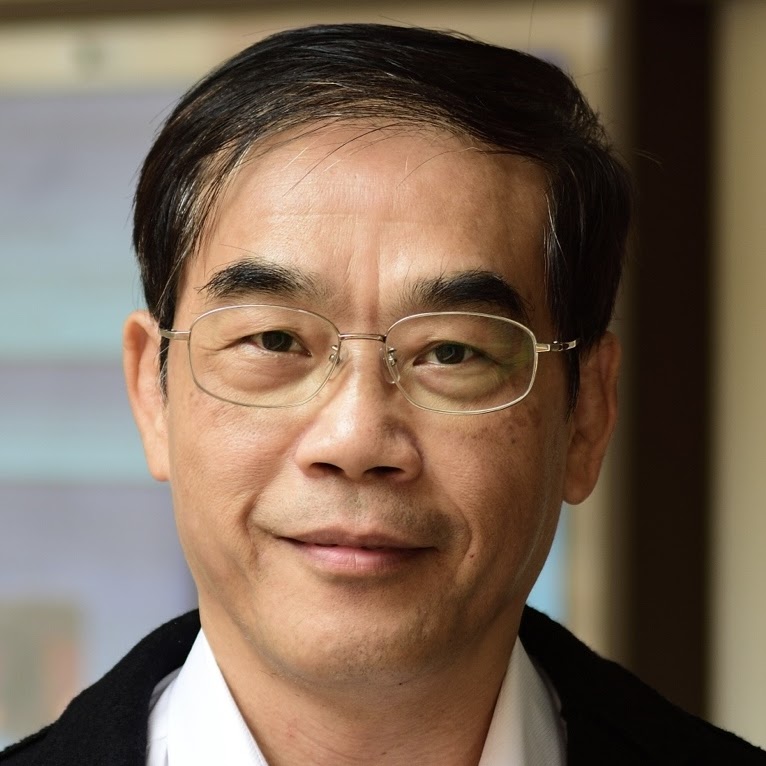
Yuh-Lin Wang
Distinguished Research Fellow
| Email: | ylwang[at]pub.iams.sinica.edu.tw |
| Office: | R303 |
| Tel: | +886-2-2366-8233 |
| Lab: | NB01 & NB02 |
| Lab Tel: | +886-2-2366-8241 |
| Surface Nanostructure Lab | |
Research Interest
- Physics and chemistry of nanostructures, application of nanotechnology to biomedical sciences, focused ion beam (FIB) technology, and surface enhanced Raman spectroscopy (SERS)
Research Overview
Dr. Yuh-Lin Wang's research focuses on the investigation of novel nanostructures and their applications. In collaboration with Dr. Ching-Ming Wei’s group, Dr. Wang has achieved important breakthroughs in the study of self-organized surface magic-number clusters (SMCs) composed of atoms and molecules. Precise construction of nanostructures on surfaces is essential for the advancement of nanoscience and nanotechnology. SMCs are stable atomic or molecular structures that form at specific sizes on particular crystalline surfaces, enabling nanostructure arrays with atomic-scale precision. Dr. Wang’s team discovered the first SMC consisting of ten gallium atoms on the Si(111) surface, constructed the first two-dimensional SMC lattice on Si(111), and, in collaboration with Russian experimentalists, observed the first molecular SMC of C₆₀ on the Au–In(111) surface. These discoveries elucidate fundamental self-organization mechanisms and open new pathways for nanoscale design with atomic precision. Beyond atomic-scale self-organization, Dr. Wang and Dr. Juen-Kai Wang have jointly created and studied uniform arrays of plasmonic “hot spots” formed by silver nanoparticles confined within anodic aluminum oxide (AAO) nanochannels for surface-enhanced Raman spectroscopy (SERS). Self-organized AAO templates provide a versatile platform for the growth of nanoparticles and nanowires, enabling adjacent silver nanoparticles to be positioned at extremely small and uniform separations, thereby generating homogeneous plasmonic hot spots. This architecture significantly enhances the sensitivity, uniformity, and stability of SERS. Collectively, these studies contribute to establishing SERS as a reliable analytical tool for practical applications, including antibiotic susceptibility testing for patients with sepsis.

Education
- B. S. Physics, 1979, National Taiwan University, Taiwan
- Ph. D. Physics, 1988, University of Chicago, USA
Professional History
- Postdoctoral Member of Technical Staff, AT&T Bell Labs, Murray Hill, New Jersey (1989-1991)
- Associate Research Fellow, Institute of Atomic and Molecular Sciences, Academia Sinica (1991-1998)
- Research Fellow, Institute of Atomic and Molecular Sciences, Academia Sinica (1998-2010)
- Adjunct Professor, Department of Physics, National Taiwan University (1999-2021)
- Chairman of the review panel for research projects in physics, Division of Natural Sciences & Mathematics, National Science Council, Taiwan (2000-2001)
- Deputy Director, Institute of Atomic and Molecular Sciences, Academia Sinica (2001-2004)
- Member of the Advisory Committee in physics, Division of Natural Sciences & Mathematics, National Science Council, Taiwan (2002-2005)
- Director, Institute of Atomic and Molecular Sciences, Academia Sinica (2004-2010)
- Member of the International Advisory Board, Journal of Physical Chemistry, U. S. A. (2007-2009)
- Distinguished Research Fellow, Institute of Atomic and Molecular Sciences, Academia Sinica (2011~)
- Member of the Advisory Board, Research Center for Applied Sciences, Academia Sinica, Taiwan (2013-2016)
- Leader of a science vanguard research project, National Science Council (2013-2017)
- Co-coordinator of the Innovation and Application of Nanoscience Thematic Program (IANTP), National Science Council, Taiwan (2014-2017)
- Leader of an academic summit project, Ministry of Science and Technology, Taiwan (2017-2022)
- Coordinator of the Innovative Materials and Analytical Technology Exploration (i-MATE) program, Academia Sinica, (2017~)
- Leader of a science vanguard research project, National Science and Technology Council (2022~)
Awards & Honors
- Outstanding research award, National Science Council, Taiwan (1992)
- Outstanding Nanotechnology Research Paper Award, Far Eastern Y. Z. Hsu Science and Technology Memorial Foundation, Taiwan (2002)
- Outstanding Scholar Award, Foundation for the Advancement of Outstanding
- Scholarship (2005-2010)
- Far Eastern Y. Z. Hsu Chair Professor (2009)
- Prime Minister Award for Outstanding Contribution in Science and Technology, Taiwan (2009)
- Investigator Award, Academia Sinica, Taiwan (2010-2014)
- Elected Fellow of Chinese Physical Society in Taipei, Taiwan (2010)
- Nanotechnology Elite Award, Ministry of Economic Affairs, Taiwan (2010)
- Elected Fellow of American Physical Society, U. S. A. (2011)
- Outstanding Research Award, Ministry of Science and Technology, Taiwan (2014)
- Academic Award, Ministry of Education, Taiwan (2016)
- Chemistry Academic Medal, Chemical Society Located in Taipei, Taiwan (2018)
Selected Publications
- “Scanning Ion Microscopy: Elemental Maps at High Lateral Resolution”, R. Levi-Setti, Y. L. Wang, and G. Crow, Invited paper, Pittsburgh Conf. on Analytical Chemistry and Applied Spectroscopy, February 1985, Appl. Surf. Sci. 26, 249-264 (1986).
- “Imaging SIMS at 20 nm Lateral Resolution: Exploratory Research Applications”, R. Levi-Setti, G. Crow, and Y. L. Wang, Keynote paper, SIMS-V, Washington, D. C., September 1985, Secondary Ion Mass Spectrometry SIMS V, A. Benninghoven, R. J. Colton, D. S. Simons, and H. W. Werner, Eds., (Springer, Berlin 1986), 132-138.
- “Role of Native Oxide Layers in the Patterning of InP Using Focused Ion Beam and Ion Assisted Cl2 Etching”, Y. L. Wang, L. R. Harriott, R. A. Hamm, and H. Temkin, Appl. Phys. Lett. 56, 749-751 (1990).
- “Semiconductor Lasers Fabricated by Selective Area Epitaxy”, Y. L. Wang, H. Temkin, R. A. Hamm, R. D. Yadvish, D. Ritter, L. H. Harriott, and M. B. Panish, Electronic Letters 27, 1324-1326 (1991).
- “Design Principles of an Optimized Focused Ion Beam System”, Y. L. Wang and Z. Shao, a chapter in "Advances in Electronics and Electron Physics," P. W. Hawkes Ed., Vol. 81, 177-210 (Academic Press, Boston, 1991).
- “Direct Observation of Two Dimensional Magic Clusters”, M. Y. Lai and Y. L. Wang, Phys. Rev. Lett. 81, 164-167 (1998).
- “Growth of Ga-Induced Nanostructures on Si(111): from Magic Clusters to Inconmmensurate Structure”, M. Y. Lai and Y. L. Wang, Phys. Rev. B 60, 1764-1770 (1999).
- “Ordered Anodic Alumina Nano-channels on Focused-Ion-beamPrepatterned Aluminum Surfaces”, C. Y. Liu, A. Datta, and Y. L. Wang, App. Phys. Lett. 78, 120-122 (2001).
- “Self-Organized Two-Dimensional Lattice of Magic Clusters”, M. Y. Lai and Y. L. Wang, Phys. Rev. B64, 241404(R)-241404-4 (2001).
- “Structure Determination of Surface Magic-Clusters”, H. H. Chang,M. Y. Lai, J. H. Wei, C. M. Wei, and Y. L. Wang, Phys. Rev. Lett. 92, 066103 (2004).
- “Fabrication of Anodic Alumina Film with Custom-Designed Arrays of Nanochannels”, N. W. Liu, A. Datta, C. Y. Liu, C. Y. Peng, H. H. Wang, and Y. L. Wang, Advanced Materials 17, 222 (2005).
- “Highly Raman Enhancing Substrates Made of Ag-Nanoparticle Array with Tunable Sub-10 nm Gaps”, Huai-Hsien Wang, Chih-Yu Liu, Shr-Bin Wu, Nai-Wei Liu, Cheng-Yi. Peng, Tsu-Hsin Chan, Chen-Feng Hsu, Juen-Kai Wang, and Yuh-Lin Wang, Advanced Materials 18, 491-495 (2006).
- “Random and ordered arrays of surface magic clusters”, Y. L. Wang, A. A. Saranin, A. V. Zotov, M. Y. Lai, and H. H. Chang (Invited Review), International Reviews in Physical Chemistry 27, 317-360 (2008).
- “A High Speed Detection Platform Based on Surface-Enhanced Raman Scattering for Monitoring Antibiotic-Induced Chemical Changes in Bacteria Cell Wall”, Ting-Ting Liu, You-Hsuan Lin, Chia-Sui Hung, Tian-Jiun Liu, Yu Chen, Yung-Ching Huang, Tsung-Heng Tsai, Huai-Hsien Wang, Da-Wei Wang, Juen-Kai Wang, Yuh-Lin Wang, Chi-Hung Lin, PLoS ONE 4(5), e5470 (2009).
- “Broken Even/Odd Symmetry in Self-Selection of Distances between Nanoclusters due to Presence/Absence of Topological Solitons”, M. Y. Lai, J. P. Chou,O. A. Utas, N. V. Denisov, V. G. Kotlyar,D. Gruznev, A. Matetsky, A. V. Zotov, A. A. Saranin, C. M. Wei, Y. L. Wang, Phys. Rev. Lett. 106, 166101 (2011).
- “Funtionalized arrays of Raman-enhancing nanoparticles for capture and culture-free analysis of bacteria in human blood”, T. Y. Liu, K. T. Tsai, H. H. Wang, Y. Chen, Y. S. Chen, Y. C. Chao, H. H. Chang, C. H. Lin, J. K. Wang, Y. L. Wang, Nat. Commun. 2, 538 (2011).
- “Stepwise self-assembly of C60 mediated by atomic scale moiré magnifiers”, D.V. Gruznev, A.V. Matetskiy, L.V. Bondarenko, O.A. Utas, A.V. Zotov, A.A. Saranin,J.P. Chou, C.M. Wei, M.Y.Lai, and Y.L. Wang, Nat. Commun. 4, 1679 (2013).
- “Looking into Meta-Atoms of Plasmonic Nanowire Metamaterial”, Kun-Tong Tsai, Gregory A. Wurtz, Jen-You Chu, Tian-You Cheng, Huai-Hsien Wang, Alexey V. Krasavin, Jr-Hau He, Brian M. Wells, Viktor A. Podolskiy, Juen-Kai Wang, Yuh-Lin Wang, and Anatoly V. Zayats, Nano Lett. 14, 4971 (2014).
- “FePt Nanodendrites with High-Index Facets as Active Electrocatalysts for Oxygen Reduction Reaction”, D. Y. Wang, H. L. Chou, C. C. Cheng, Y. H. Wu, C. M. Tsai, H. Y. Lin, Y. L. Wang, B. J. Hwang, and C. C. Chen, Nano Energy 11, 631 (2015).
- “Highly Active and Stable Hybrid Catalyst of Cobalt-Doped FeS2 Nanosheets−Carbon Nanotubes for Hydrogen Evolution Reaction”, D. Y. Wang, M. Gong, H. L. Chou, C. J. Pan, H. A. Chen, Y. Wu, M. C. Lin, M. Guan, J. Yang, C. W. Chen, Y. L. Wang, B. J. Hwang, C. C. Chen, and H. Dai, J. Am. Chem. Soc. 137, 1587 (2015).
- “Quantification of biomolecules responsible for biomarkers in the surface-enhanced Raman spectra of bacteria using liquid chromatography-mass spectrometry”, Shirley W. Y. Chiu, H. W. Cheng, Z. X. Chen, H. H. Wang, M. Y. Lai, J. K. Wang and Y. L. Wang, Phys. Chem. Chem. Phys. 20, 8032 (2018).
- “Antibiotic Susceptibility Test with Surface-Enhanced Raman Scattering in a Microfluidic System”, K. W. Chang, H. W. Cheng, Jessie Shiue, J. K. Wang, Y. L. Wang, and N. T. Huang, Anal. Chem. 91, 10988 (2019).
- “Rapid antibiotic susceptibility testing of bacteria from patients' blood via assaying bacterial metabolic response with surface-enhanced Raman spectroscopy”, Y. Y. Han, Y. C. Lin, W. C. Cheng, Y. T. Lin, L. J. Teng, J. K. Wang, and Y. L. Wang, Scientific Reports, 10:12538 (2020).
- “Bacteria encapsulation and rapid antibiotic susceptibility test using a microfluidic microwell device integrating surface-enhanced Raman scattering”, H. K. Huang, H. W. Cheng, C. C. Liao, S. J. Lin, Y. Z. Chen, J. K. Wang, Y. L. Wang, and N. T. Huang, Lab on Chip, 20, 2520 (2020).
- “Sensible Functional Linear Discriminant Analysis Effectively Discriminates Enhanced Raman Spectra of Mycobacterium Species”, W. C. Cheng, L. H. Chen, C. R. Jiang, Y. M. Deng, D. W. Wang, C. H. Lin, R. W. Jou, J. K. Wang, and Y. L. Wang, Analytical Chemistry 93, 2785 (2021).
- “Atomically-resolved interlayer charge ordering and its interplay with superconductivity in YBa2Cu3O6.81”, C. C. Hsu, B. C. Huang, Michael Schnedler, M. Y. Lai, Y. L. Wang, Rafal E. Dunin-Borkowski, C. S. Chang, T. K. Lee, Philipp Ebert and Y. P. Chiu, Nat. Comm. 12, 3839 (2021).
- “SERS‑based rapid susceptibility testing of commonly administered antibiotics on clinically important bacteria species directly from blood culture of bacteremia patients”, Y. Y. Han, J. T. Wang, W. C. Cheng, K. L. Chen, Y. Chi, L. J. Teng, J. K. Wang, and Y. L. Wang, World Journal of Microbiology and Biotechnology 39, 282 (2023).